Wagner, Musical Progressivism, and the Neudeutsche Schule
The late 19th century was an era of artistic upheaval, and despite the composer’s reputation, Richard Wagner’s music was no exception and among the most progressive of its time. His upending of virtually all previous musical norms was perhaps the biggest revolution in western music and put him at the forefront of the “Neudeutsche Schule” (New German School), a loose association of composers, critics, musicians, and many other influential personalities in the late 19th century German art scene which sought to lay out their views for where music should go heading into the turn of the century. Uniting these musical allies was first and foremost a thirst for new developments, for radical, musically progressive harmony and chromaticism, while fearlessly empowering their musicians to draw unprecedented power and emotion from what was then considered possible in the musical world.
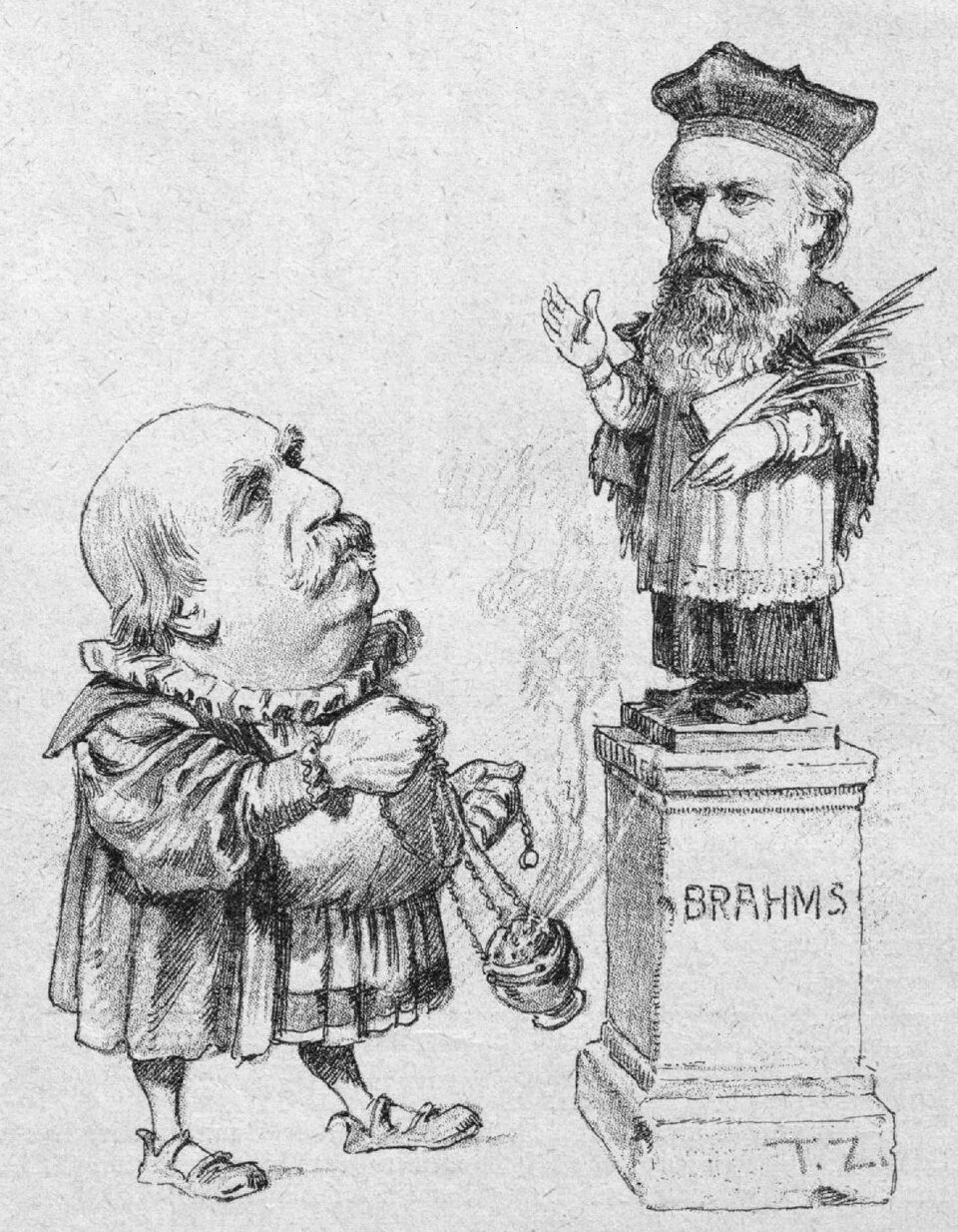
Conservative critic Eduard Hanslick offering incense to Johannes Brahms, cartoon from the Viennese journal 'Figaro', Theo Zasche, 15 March 1890
Ironically, Johannes Brahms himself was one of the biggest foes of Wagner’s new school of musical thought. Even today, little would bring to mind a close musical association of these two classical giants with one another: Brahms wrote four symphonies, Wagner just one (and who’s ever heard it performed?), Wagner thirteen stage works, Brahms none. But why is this so? After all, both composers were active in the German-speaking music world during the second half of the 19th century: Brahms first in Hamburg, later in Vienna; Wagner first in Dresden, then in his political asylum in Zurich, and finally in Bavaria. Geographically and temporally, there seems to be quite an overlap between the two composers. But do these seemingly obvious parallels also carry through into the notes with which these two composers left their lasting mark on music history?
Quite the opposite: while today, Brahms’ and Wagner’s works are regularly seen side by side on concert programs and many Wagner specialists such as Christian Thielemann, Daniel Barenboim and Pierre Boulez have performed and recorded Brahms to great acclaim, the two composers were actually musical rivals during their time. Hardly any musician of the 19th century not adhering to the ideology of Wagnerism was spared the wrath of Richard’s ruthless animosity, but Brahms, having completely left the field of opera to Wagner and his rivals, wasn’t really much of a problem for Wagner when it came to securing venues, funds and fame for the premieres of his stage works. Rather, he represented an entirely different approach to the development of music in the late 19th century than what Wagner had in mind.
For Wagner especially, this was all about getting rid of old norms: While we can still find “Arias” and “Ouvertures” in some of his early works such as Der fliegende Holländer or Rienzi, by the time he wrote Das Rheingold he had abandoned virtually all aspects of the romantic opera, a form of entertainment he disdained, in favor of an uninterrupted “Gesamtkunstwerk” (total work of art) with a web of musical motives and immersing the audience in the chromaticism of his “Zukunftsmusik” (Music of the future). This was in stark contrast to the more conservative approach of Brahms, who was accused by critics such as Friedrich Nietzsche of being a “master of copying” and by Wagner himself of showing up “wearing Händel’s Hallelujah-wig”. His reputation as Beethoven's only legitimate musical heir was seen as an expression of great admiration by his followers, and as proof of a supposed lack of originality in his musical creations by his foes.
Gustav Mahler conducts the Vienna Philharmonic Orchestra, Max Oppenheimer, detail, oil and tempera on canvas, 1926-1952, Belvedere Museum, Vienna, Austria, 1935-1952
The New German School didn’t exactly end with Wagner’s death (or Liszt's, another close musical ally of Wagner’s, for that matter), with many composers such as Richard Strauss, Hugo Wolf, and Gustav Mahler lining up to carry and evolve Wagner's musical achievements into the new century. Strauss was arguably the most obvious contender for the title of Wagner’s “musical successor”, with his operas and tone poems borrowing much more than the Wagner tubas from his idol, but it was Mahler who perhaps most closely set forth Wagner’s musical legacy of breaking with old traditions. While he didn’t dare touch the signature genre — stage works — of his favorite composer, his revolution of the symphony was probably at least equally daring and controversial, especially his monumental Eighth Symphony stretching the limits of what was at the time performable, just as Wagner had set unprecedented demands on his musicians when writing his works a few decades earlier. Never mind that Mahler’s music is filled with Wagner quotes as far as the ear can hear. To name a few, the finales of the first and third symphonies famously allude to Parsifal, a work which had left Mahler breathlessly stunned when he heard it in Bayreuth in 1883, and the many parallels between the last movement of the seventh and Wagner's Meistersinger have been the subject of much scholarly work.

Tristan Drinking the Love Philtre (Engraving in The Story of Tristan and His Adventures, Including His Love Story with Isolde, from Sir Thomas Malory), Edition Illustrated by Aubrey Beardsley, 1893-1894
But what really makes the spirit of the New German School is not so much the musical styles of its founders — Liszt, Wagner and their contemporaries — but rather their taste for radically new developments in the evolution of music. This is perhaps most evident in Wagner’s chromaticism, often attributed as a signature element of Tristan und Isolde and most developed in Parsifal. If we look at the first act of Parsifal, yes, the prelude has some kind of musical closure in the sense that it opens and closes in A-flat-major. But really, the entire music seamlessly evolves from one deceptive cadence to the next; a tonal stability really doesn’t settle in for the whole one hour and usually forty minutes the audience spends indulged in the holy world of the grail knights. In this work, Wagner goes as far as he can from traditional harmony without abandoning tonality entirely, a task he would leave for Schönberg to complete. Let’s not forget, Parsifal was written in the late 1870s and premiered in 1882, just six years after the world witnessed the birth of Brahms’ first symphony, which adheres to the classical rules of a C minor symphony not any less than Beethoven did in his fifth symphony.
To that extent, there is some truth to the accusations against Brahms of being stuck in the old forms and adhering too much to the musical past. But the same could also be said about Richard Strauss’ Vier letzte Lieder, which musically could be read as an epitome of late romanticism. Strauss wrote these songs in 1948 and had them premiered in 1950, at a time when elsewhere the seeds of serialism were being laid by Karlheinz Stockhausen and Pierre Boulez. Which is exactly why one must question to what extent Strauss should actually be counted among the progressives in music history. We must also question the stringent association of the New German School with a few set names who, at some point in time, happened to pursue a similar path in their compositional work. Strauss’ Elektra (premiered 1909) was plenty progressive, but while the evolution of Mahler’s symphonies into the realm of Schönberg’s twelve-tone music was really only interrupted by the composer’s early death in 1911, Strauss later jumped onto a musically more conservative train, building much more onto the success of his highly popular works such as Der Rosenkavalier or Eine Alpensinfonie rather than attempting more bold artistic experiments.
The legacy and spirit of the Neudeutsche Schule must be found in its thirst for new developments, for radical, musically progressive change, and for driving its art forward into the music of the future.